
Dillon AP Mechanical Dynamometers — In Stock, Expert-Specified, Ship Fast
The Dillon AP Mechanical Dynamometer has been the standard in utility, aerospace, and industrial force measurement for over 80 years — and for good reason. No batteries. No software. Just proven mechanical accuracy from 500 lb to 50,000 lb, built to survive the conditions your crews work in every day.
At Dynamic Measurement Systems, we stock the AP models your operation actually needs — including the most in-demand 5″ and 10″ dial variants — so you’re not waiting 14–15 weeks on a factory order when your equipment is grounded. We ship fast. We spec right. We answer the phone.
Ready to move?
Shop AP Mechanical Dynamometers

Dillon AP Mechanical Dynamometer 10” Dial 10,000 lb x 50 lb 30007-0083
Dillon AP Mechanical Dynamometer 10” Dial 10,000 kg x 50 kg 30007-0117
Dillon AP Mechanical Dynamometer 10” Dial 20,000 lb x 100 lb 30007-0109
Dillon AP Mechanical Dynamometer 10” Dial 20,000 kg x 100 kg 30784-0058
Dillon AP Mechanical Dynamometer 10” Dial 30,000 lb x 200 lb 30784-0017
Dillon AP Mechanical Dynamometer 10” Dial 50,000 lb x 100 lb 30784-0033

Dillon AP Mechanical Dynamometer 5” Dial 10,000 lb x 100 lb Model 30006-0084
Dillon AP Mechanical Dynamometer 5” Dial 10000 kg x 100 kg 30006-0118
The standard for 80+ years
What Is the Dillon AP Mechanical Dynamometer?
The Dillon AP is a mechanical dial dynamometer — a rugged, self-contained force measurement instrument that requires no power source, no data connection, and no calibration software to operate in the field. Unlike modern dynamometers that rely on a transducer or strain gauge to convert force into an electrical signal, the AP reads the force exerted between two attachment points directly on an analog dial face — with no electronics to fail in the field.
The AP design has remained fundamentally unchanged since its introduction decades ago — not because it hasn’t been updated, but because it was engineered right from the start. The 5″ dial format is the most widely used in the field. The 10″ dial provides higher-resolution readings for large-capacity applications where finer increments matter.
Available in both imperial (lb/lbf) and metric (kg/kgf) configurations, the AP is built to ASME B30.26 standards up to 20,000 lbs and carries CE certification. Proof load is rated at 150% of instrument capacity, giving you a meaningful safety margin in demanding lift and tension applications.
The AP is a mechanical dynamometer, not a load cell — it requires no signal conditioning, voltage excitation, or data acquisition hardware to operate. Dynamometers measure force in many ways; the AP does it with a precision flexing beam and dial that has proven itself across decades of field dynamometry.
Key AP Specifications at a Glance
| Specification | Detail |
|---|---|
| Capacity Range | 500 lb to 50,000 lb (226 kg to 22,680 kg) |
| Dial Sizes | 5-inch and 10-inch |
| Units of Measure | lbf or kgf (imperial and metric variants available) |
| Accuracy | u00b10.5% of instrument capacity |
| Operating Temperature | u201350u00b0F to 140u00b0F (u201346u00b0C to 60u00b0C) |
| Proof Load | 150% of capacity |
| Certifications | CE / ASME B30.26 (up to 20,000 lb) |
| Recalibration Interval | Annually (NIST-traceable) |
| Power Required | None u2014 fully mechanical |
| Typical Service Life | 10u201315 years with proper maintenance |

Dillon AP 5″ dial · isolated product photo
Spec the right format
5″ Dial vs. 10″ Dial — Which AP Do You Need?
This is the most common question we get. Here's the practical answer:
Dillon AP 5″ Dial
Compact, portable, and battle-tested in utility line work, rigging, and field tension measurement. It's the format used by the majority of utility contractors in the US for power line sagging and storm restoration operations.
Best for: Utility line crews, general rigging, portable field use, standard capacity up to 20,000 lb.
Shop AP 5″ DialDillon AP 10″ Dial
The 10″ dial face gives you higher visual resolution at the same capacity — the larger display and finer graduation increments make it easier to read precise load values, particularly for high-capacity applications in the 20,000–50,000 lb range.
Best for: High-capacity applications, precision load testing, shop or fixed-installation use, finer reading increments.
Shop AP 10″ DialMatch capacity to the job
AP Mechanical Dynamometer Capacity Guide
The three most widely purchased AP capacities — which together represent the majority of AP sales worldwide — are the 5,000 lb, 10,000 lb, and 20,000 lb models. These cover the core range for utility line tensioning, construction rigging, and industrial load measuring applications. Match the capacity to the load applied — selecting the right range ensures accurate readings and protects the instrument from over-ranging.
| Capacity | Typical Applications | Dial Size Options |
|---|---|---|
| 500 lb u2013 2,000 lb | Light rigging, equipment testing, lab use | 5" |
| 4,000 lb u2013 5,000 lb | Utility guy wire work, light line tensioning | 5" |
| 8,000 lb u2013 10,000 lb | Primary utility line sagging, general contractor rigging | 5" / 10" |
| 20,000 lb | Heavy utility line work, industrial crane rigging | 5" / 10" |
| 30,000 lb u2013 50,000 lb | High-capacity industrial and heavy lift applications | 10" |
Not sure which capacity fits your application? We've spec'd dynamometers for utility, aerospace MRO, and oil field operations. We'll tell you exactly what you need — and whether it's in stock.
Built for the field
Who Specifies the Dillon AP — and Why
The Dillon AP is the dominant mechanical dynamometer across two demanding, compliance-driven industries. Its no-power, no-setup design means crews can measure tension and weight in the field immediately — never waiting on electronics to boot or batteries to charge.
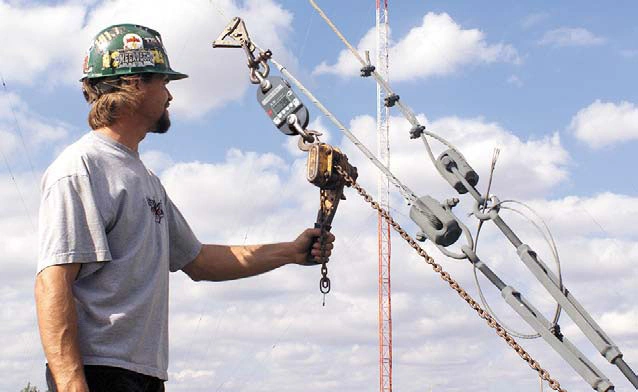
Why Utility Contractors Rely on It
- Power line sagging & tensioning — conductor and overhead ground wire tension during stringing
- Storm restoration — rapid deployment across variable operating conditions when downtime isn't an option
- Guy wire tensioning — verifying tension on utility pole anchor systems
- Pulling operations — monitoring the force applied during cable and conductor pulls
Why Aerospace & Defense Specify It
There are other distributors
Why Buy From Dynamic Measurement Systems
Here's what makes us different — in plain terms.
We Actually Have It in Stock
We Spec It Right the First Time
Every Unit Ships Calibration-Current
Rental for High-Capacity Jobs
Calibration & Repair Under One Roof
Built for the long haul
AP Dynamometer Maintenance & Service Life
The Dillon AP is built for the long haul. With proper maintenance and annual recalibration, AP dynamometers typically remain in service for 10–15 years across demanding operating conditions. The mechanical design means there are no circuit boards, no batteries, and no digital components to fail in the field.
Common service items over the life of an AP unit include:
- Annual NIST recalibration — required by most utility and aerospace quality systems
- Dial pointer or spring replacement — wear items on high-cycle units
- Shackle or housing inspection — particularly on units used in storm restoration or high-frequency deployment
We stock replacement parts and can diagnose repair needs quickly. Most repairs are completed and returned within a standard service window. Support & Technical Information →
Not Sure Which Type of Dynamometer Fits Your Application?
The AP is a mechanical instrument — it doesn't log data, connect wirelessly, or output to a computer. If your application requires one of these, consider a Dillon electronic dynamometer instead:
Still unsure? Call us at 281-405-0606 and we'll help you spec the right instrument for your application and budget.
Answers before you buy
Frequently Asked Questions
How often does the Dillon AP need to be calibrated?
Annual recalibration is the standard interval required by most utility, aerospace, and industrial quality systems. NIST-traceable calibration is available through our Houston facility — ship your unit to us, and we’ll return it calibrated with a dated certificate. Standard fee is $295; expedited is $395. Request calibration here →
What is the difference between the 5″ and 10″ dial AP models?
Both measure force using the same proven AP mechanism. The 10″ dial provides a larger display with finer graduation increments — particularly useful for high-capacity applications (20,000 lb and above) where reading accuracy at a distance or in fine increments is important. The 5″ dial is the most widely used format for general utility and field applications.
Can I order an AP dynamometer in metric (kg) capacity?
Yes. AP models are available in both imperial (lb/lbf) and metric (kg/kgf) configurations. Filter by your preferred unit of measure in the product listings above, or call us and we’ll confirm availability for the specific metric capacity you need.
Do you have AP dynamometers in stock or is there a lead time?
We maintain on-hand inventory across the most in-demand AP capacities. In most cases, we can ship same or next business day from our Houston facility — compared to 14–15 week lead times when ordering through the factory. Call us at 281-405-0606 to confirm current stock on your specific model.
Can the Dillon AP be used in aviation or aerospace applications?
Yes. The AP is used in MRO, rigging, and structural applications throughout the aerospace supply chain. We hold CAGE Code 1W4R9 for federal and defense procurement, and our calibration certificates meet NIST traceability documentation requirements for aerospace quality systems. Contact us to discuss your specific application →
What happens if my AP dynamometer fails in the field?
Ship it to our Houston facility and our factory-trained technicians will diagnose the issue and provide a repair quote before any work begins. We stock common replacement parts and can typically turn around repairs faster than ordering a replacement from the factory.
Can you supply custom capacity configurations?
Yes. We can configure non-standard capacity ratios for specialized applications — for example, 3-to-1 ratio configurations used in pipe torquing operations. Call us at 281-405-0606 or submit a custom request here → and we’ll discuss your requirements.
How Do Torque Dynamometers Differ From Force Dynamometers Like the Dillon AP?
Torque dynamometers measure the rotational output of a motor or engine — capturing torque and rotational speed simultaneously to calculate power curves across a test range. Force dynamometers like the Dillon AP measure the force exerted along a single axis — tension or compression between two fixed points — with no rotational component involved. When specifying the right instrument, measurements of torque require a rotary torque transducer or engine dyno; measurements of static line tension or load require a force dynamometer.
What Types of Dynamometer Systems Are Used in Engine and Powertrain Testing?
Engine test dynamometer systems fall into two broad categories: absorption dynamometers, which dissipate the energy output of the unit under test, and motoring dynamometers, which can both absorb and apply torque to simulate real-world load conditions. Common absorption designs include hydraulic dynamometer (water-brake) units, eddy-current models, and air cooled friction types. More advanced AC dynamometer setups use an electric motor to reproduce transient test profiles and replicate full test cycle conditions — standard in automotive engine development and powertrain certification for environmental regulations in a controlled test cell environment.
What Does a Transducer Do in an Electronic Dynamometer?
In an electronic dynamometer, a transducer converts the physical force applied into an electrical signal that can be displayed, logged, and transmitted digitally. Most digital dynamometers use a strain gauge-based transducer bonded to a load-bearing element — when the element deflects, the gauge changes resistance proportionally, producing a measurable output. The Dillon AP operates without a transducer — it measures the force directly through a calibrated flexing beam and dial face.
How Is Force Exerted Measured in a Mechanical vs. Electronic Dynamometer?
A mechanical dynamometer measures the force exerted through a precision flexing beam — deflection under load moves a dial pointer proportional to the applied weight or tension. Calibration is verified against a known mass at the factory and confirmed annually through NIST-traceable recalibration. In an electronic dynamometer, the same force applied is digitized by a transducer and output as dynamometer measurements that can be logged and reviewed — making electronic models better suited for applications requiring ongoing data acquisition and full traceability.
Is the Dillon AP Suitable for Powertrain or Automotive Engine Testing?
No — the Dillon AP is a tension and compression force dynamometer, not an engine or powertrain test instrument. Automotive applications — including chassis dyno testing and measuring the performance of engines under load — require rotary dynamometers built to measure torque and speed from a rotating shaft. The AP is used in utility, rigging, aerospace, and industrial applications where the goal is to measure the force exerted along a cable, line, or structural member — not the rotational output of a drivetrain.
What Is the Difference Between an Eddy-Current and a Water-Brake Dynamometer?
An eddy-current dynamometer uses electromagnetic resistance — induced by a rotor spinning through a magnetic field — to absorb the torque produced by an engine or motor under test. A water-brake dynamometer achieves a similar result using hydraulic pressure, metering water through a rotor and stator to dissipate energy as heat. Eddy-current designs offer finer control at constant torque and are well-suited to transient testing; water-brake units are preferred for high-power applications where raw absorption capacity matters more than precise torque and power profiling.
What Causes Measurement Error During High-Speed Dynamometer Testing?
Accuracy during transient conditions can be affected by hysteresis in mechanical components, system resonance, and the rate of acceleration through a test range. Electronic dynamometer systems compensate through high-speed sampling and calibration corrections applied in the data acquisition chain. For static force dynamometers like the Dillon AP — used in low-speed tension and load applications — hysteresis is managed through proper calibration against a known mass and by operating within the rated capacity range.
Can Dynamometers Be Used to Measure Grip Strength or Clinical Force?
Yes — handheld medical dynamometers are designed specifically to measure grip strength and upper extremity force output in clinical and ergonomic settings. Brands such as Régnier produce calibrated hand dynamometers used in occupational therapy and musculoskeletal assessment. These instruments measure the force exerted by a patient against a resistance mechanism and are an entirely separate product category from the industrial tension dynamometers Dynamic Measurement Systems supplies.
Yes, it's in stock.
Ready to Order or Need a Quote?
If you know exactly what you need, add it to your quote above. If you want to confirm availability, discuss quantity pricing, or spec the right model — call us or request a quote and you'll hear back from a real person who knows this product.